Video Testimonial Questions: 7 That Work (From 600+ Shoots)
Stop asking 'tell us about your experience.' Use these 7 video testimonial questions, with follow-ups and example answers, to get clips you can actually publish.
In short
The single biggest determinant of testimonial quality isn't the customer or the camera, it's the question. Ask specific, sensory, time-anchored questions and you'll get specific, sensory, quotable answers. Vague questions produce vague tape.
The short answer#
The best video testimonial questions are specific, tied to a moment, and limited in time. "Tell us about your experience" gets vague footage. "Walk me through the first time you saw it work" gets a clip you can put on a homepage.
Use 3 to 5 of the 7 questions below. Send them to the customer 24 hours before recording. Ask one follow-up after every answer. (The ask and the timing are covered in our collection playbook.)
I have directed about 600 testimonial shoots over fifteen years, for documentaries, brand films, and now SaaS companies through Proofly. One thing separates unusable tape from a clip that closes deals: the question.
The 7 questions at a glance#
| # | Question | What it produces |
|---|---|---|
| 1 | "What were you trying to do that wasn't working?" | The "before" state |
| 2 | "Walk me through the first time you saw it work." | The moment of recognition |
| 3 | "What did you tell your team after the first week?" | The internal narrative |
| 4 | "What would have happened if you hadn't found us?" | The stakes |
| 5 | "What surprised you?" | Fresh, unrehearsed language |
| 6 | "Who else should be using this and isn't?" | Advocacy and your ICP in their words |
| 7 | "If I gave you 10 seconds to convince a friend, what would you say?" | The soundbite |
1. "What were you trying to do that wasn't working?"#
Use this as your opener. It anchors the customer in a specific moment of frustration.
Keep it in the past tense. The past tense lets them be honest about a problem without sounding like they are complaining about a current vendor.
What it produces: the "before" state in the customer's own words. Almost every great testimonial opens with a clear before, because contrast makes the after feel real.
Follow-up if they stay abstract: "Can you remember a specific day or week when that frustration peaked?" That question gets you the scene.
2. "Walk me through the first time you saw it work."#
This question produces the moment of recognition. People remember moments better than processes.
You get answers like this:
"I sent the link Tuesday afternoon and by Wednesday morning we had four videos. I called Mike and said, this is the thing."
That is a homepage clip.
3. "What did you tell your team after the first week?"#
This pulls out the internal narrative: how the customer described you to people whose opinion they care about. It is usually more vivid than what they say to a vendor's camera.
The phrase "after the first week" does the work. It bounds the answer in time and forces specifics. "What do you tell your team about us?" gets platitudes. The week anchor gets you something close to a real Slack message.
4. "What would have happened if you hadn't found us?"#
This is the counterfactual. It is where the stakes come from.
Most testimonials skip it because it feels presumptuous. Customers usually enjoy answering it, because it lets them tell a story where they made a smart decision.
Use it once per video. Two counterfactuals start to sound like a sales script.
5. "What surprised you?"#
This is the most underused question in testimonial interviewing. Surprise produces original language, because the customer has not rehearsed an answer.
The best line I ever got came from this question. The customer said:
"How quiet it got. I stopped getting Slack messages about the thing."
That line made the cut.
6. "Who else should be using this and isn't?"#
This is the referral question, framed as advocacy instead of an ask. It positions the customer as a generous expert recommending a tool to a peer.
The bonus: their answer doubles as your ideal customer profile in the words of a real customer. Pull these clips into sales decks (see how to use social proof in sales).
7. "If I gave you 10 seconds to convince a friend, what would you say?"#
This is the closer. It is time-boxed, personal, and casual.
It produces the soundbite: the 8 to 12 second clip you cut for ads, social, and the top of landing pages.
The "10 seconds" matters. "What would you say to a friend?" gets a paragraph. The time limit gets you the headline.
How to get a number when customers say "it saved us time"#
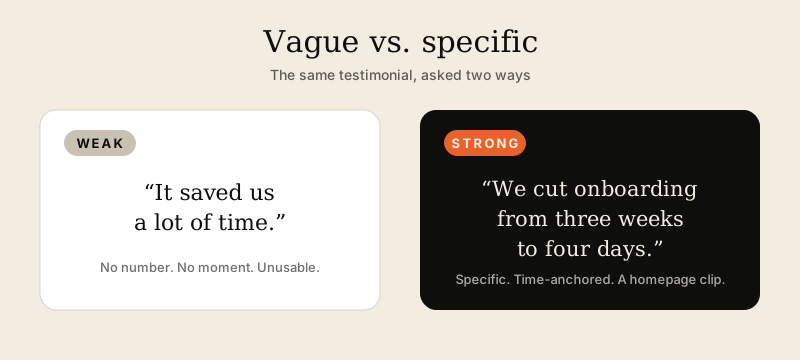
Ask for the number, not the adjective. Three follow-ups turn vague praise into a quotable metric.
Every competing guide recommends a results question. Testimonial.to suggests asking what results the customer saw and how they measured them, then narrowing to time saved, revenue gained, or fewer errors.
Add these follow-ups to any answer that sounds like praise without proof:
- "Roughly how much time per week or per project?"
- "What were you comparing that to?"
- "How do you know the change is real?" Clareefai makes the same point: ask for the number, not the adjective. "How much faster, roughly?" beats "Was it faster?"
If the customer has no hard metric, keep the answer anyway. A clear before and after in plain language beats a number they cannot defend.
One add-on question for buyers on the fence#
Add this when your audience is comparing options: "What almost stopped you from choosing us?"
Clareefai groups this under the "discovery and decision" stage, because prospects watching are usually mid-evaluation themselves. It answers the question they are actually asking: why did this person pick this tool?
Ask it once, and only when the customer sounds comfortable.
Which questions to send to which customer#
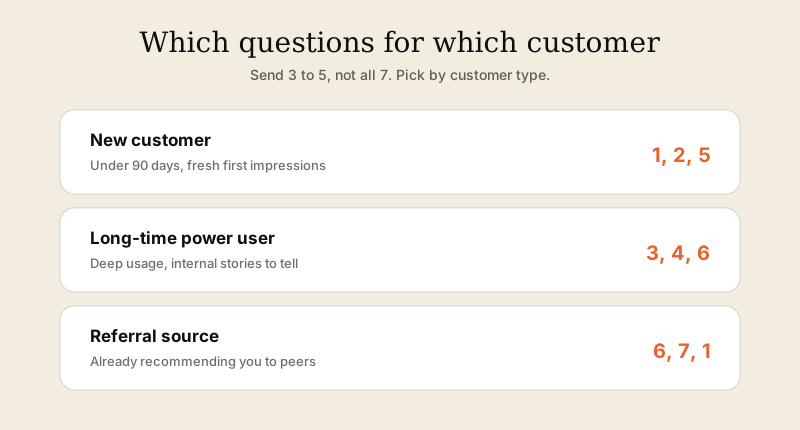
Send three to five questions, not all seven. Pick based on what you already know about the customer.
| Customer type | Use questions |
|---|---|
| New customer (under 90 days) | 1, 2, 5 |
| Long-time power user | 3, 4, 6 |
| Referral source | 6, 7, 1 |
Put the questions in story order#
Order matters. A testimonial that jumps to "and now everything is great" skips the part that builds trust.
Follow this order: before, moment, result, advocacy. Clareefai describes a six-stage arc (background, problem, decision, implementation, results, recommendation) and suggests picking one or two questions per stage.
With this post's questions, a tight three-question interview looks like this: Question 1 (before), Question 2 (moment), Question 7 (advocacy).
Phrase questions so answers sound real#
Three rules keep answers honest and quotable:
- Ask open, not yes/no. "What was it like working with us?" beats "Did you like working with us?"
- Stay neutral. "What changed with your budget?" beats "How much did we save you?"
- Ask for specifics. Numbers, days, and moments beat adjectives. Clareefai covers all three rules in detail.
The one question to never ask#
"Is there anything else you'd like to add?"
This is how every bad testimonial ends. After ten polite minutes, the customer fills the silence with a generic thank-you. That line becomes the closing card and undoes everything before it.
If you need a closer, ask one of the seven again with slightly different framing. Or end on Question 7 and let the soundbite carry it.
People also ask about testimonial questions#
Should I give customers a script or just the questions?
Just the questions. A customer reading someone else's words looks like a customer reading someone else's words. Send the seven as prompts, never as lines to recite, and never pay for a positive testimonial. If compensation was involved (a discount, a gift, a free month), disclose it next to the video.
What is the first question I should ask?
The intro: name, role, company, in one sentence. Ask for it separately from the seven, not as one of your picks. "I'm Maya, head of growth at Acme" takes five seconds to record and makes every clip that follows more credible, because the viewer knows who is talking.
Do B2B and B2C testimonials need different questions?
The seven work for both, but the emphasis shifts. B2B buyers need the counterfactual (question 4) and the internal narrative (question 3), because committees decide and skeptics join late. B2C buyers respond more to the moment of recognition (question 2) and the soundbite (question 7), because individuals decide fast.
How do I record a remote testimonial that doesn't look remote?
Ask the customer to record where they work, not against a blank wall. A customer in their office, shop, or studio gives the viewer context for free. Face a window for light, keep the phone at arm's length, do one take, and leave small imperfections in. A slightly awkward real customer beats a polished one.
How to send the questions#
Send the questions 24 hours before recording. Give no script and no expectation of polish. Something like this works:
"Here's what I'd love to hear about. Whenever you have a quiet ten minutes."
Other guides suggest more lead time. Testimonial.to recommends sending questions 24 hours ahead. Clareefai recommends 48 hours so customers can gather real numbers. Use 24 hours for quick, no-pressure recordings. Use 48 hours when you want metrics.
If you collect through a single browser link with no login, completion goes up. Read the full playbook for the measured before-and-after across 230 teams.
Recording basics#
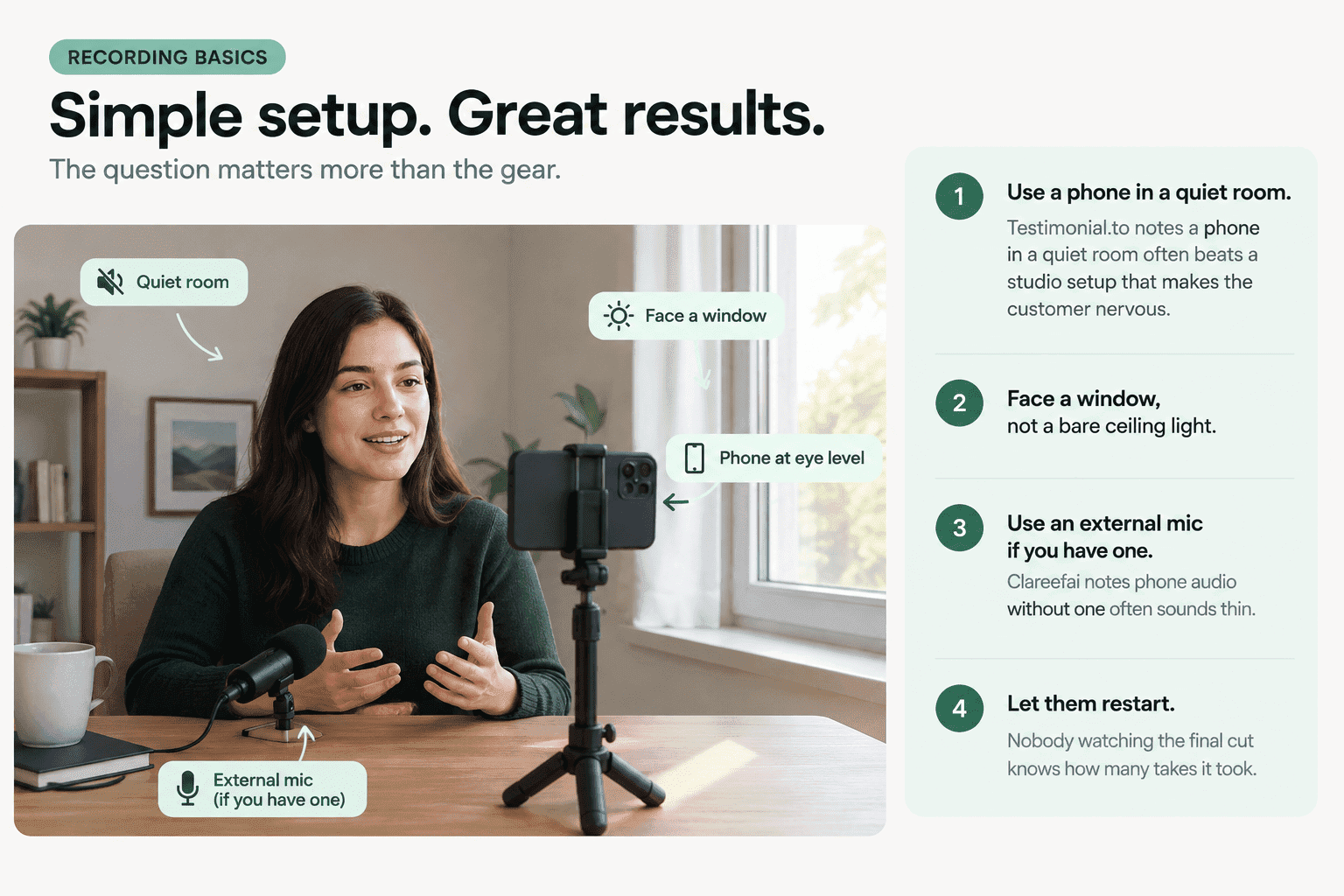
Keep this short. The question matters more than the gear.
- Use a phone in a quiet room. Testimonial.to notes a phone in a quiet room often beats a studio setup that makes the customer nervous.
- Face a window, not a bare ceiling light.
- Use an external mic if you have one. Clareefai notes phone audio without one often sounds thin.
- Let them restart. Nobody watching the final cut knows how many takes it took.
Consent and disclosure#
Get a signed release before you publish. If you gave a discount, gift, or payment in exchange for the testimonial, disclose it.
Clareefai summarizes the checklist: a signed release, a written note of any compensation, a disclosure line when compensation was involved, and the customer's approval of the final cut. For the rules themselves, see the FTC's endorsement guide FAQ.
Turn one recording into several assets#
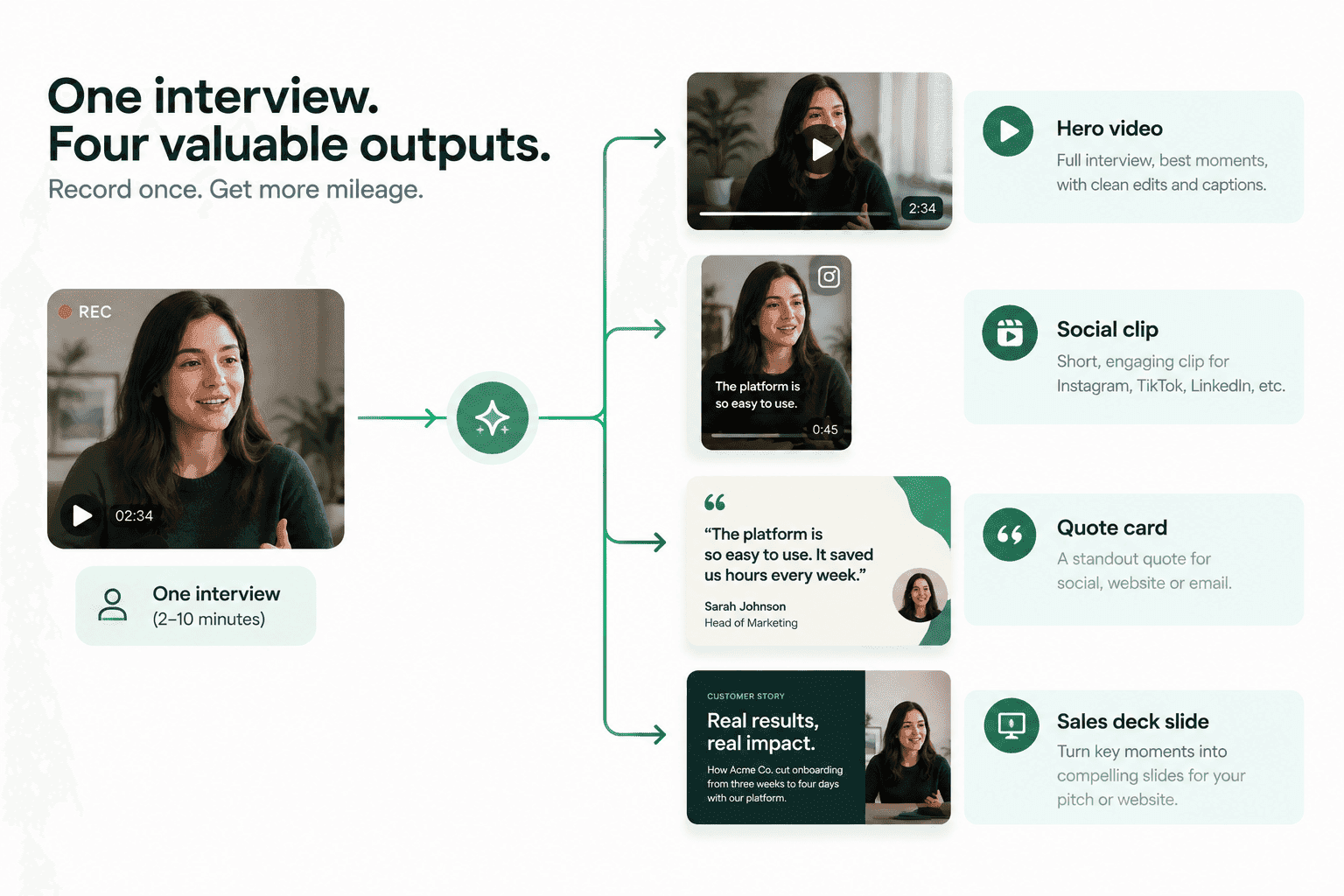
One interview can produce more than one clip. Map each question to a format. For longer-form case study interviews, see client interview questions for case studies:
| Question | Best use | Length |
|---|---|---|
| 7 (10 seconds) | Ads, top of landing page, social | 8-12 seconds |
| 5 (surprise) | Social clip, quote card | 15-30 seconds |
| 1 and 2 (before and moment) | Hero video, homepage | 60-90 seconds |
| 6 (who else) | Sales deck, ICP page | 15-30 seconds |
Clareefai suggests a 60 to 90 second hero video and 15 to 30 second social clips from a single shoot.
We measured what a testimonial wall does on a landing page. See the results: How we increased landing page conversion by 31% with video testimonials.
FAQ#
What are good video testimonial questions?#
Good video testimonial questions are specific, tied to a moment, and time-bound. Examples: "Walk me through the first time you saw it work" and "What did you tell your team after the first week?" Avoid broad prompts like "Tell us about your experience."
How many questions should I ask?#
Three to five. More than five, and customers treat it like homework and skip parts. Fewer than three, and you may not have enough material to edit.
Should customers see the questions in advance?#
Yes. Send them 24 to 48 hours ahead with no script. A little preparation produces tighter, more confident answers than a cold start.
What is the worst video testimonial question?#
"Tell us about your experience with [product]." The customer does not know where to start, so they give a high-level summary you cannot use.
How long should a video testimonial be?#
Plan for a short recording and a shorter edit. A hero clip usually runs 60 to 90 seconds. Social clips run 15 to 30 seconds. A soundbite from Question 7 runs 8 to 12 seconds.
Try it this week#
Pick three questions, send them tomorrow, and record on a phone. If you want the collection part handled, Proofly gives you one link (pricing). Customers record in any browser with no app.
Start free with Proofly and collect five video testimonials this week.
Common questions
How many questions should I send a customer?
Three to five. More than five and the customer treats it like homework and skips. Fewer than three and you don't have enough material to edit. The seven questions in this post are a menu — pick the four that fit the customer you're recording with.
Should customers see the questions in advance?
Yes. Send them a day ahead with no expectation of a polished answer. Customers who see the questions cold under-perform by about 40% on usability: they ramble, hedge, and re-take. A day to think produces tighter, more confident takes.
What's the worst question to ask?
'Tell us about your experience with [product].' It's the single most common opener and it produces the worst tape. The customer has no idea where to start, so they default to a high-level summary that's unusable. Ask about a specific moment instead.